



This fascinating and heartbreaking case just broke on CNN:
Lori Stodghill arrived at the ER of St. Thomas More Hospital in severe distress; she was 28 weeks pregnant. (Full term is usually considered to be around 36 or 37 weeks.) She and the twin boys she was carrying died, and her husband sued the hospital. The hospital–a Catholic institution–has now argued that the twins were not legally people, and therefore did not have a right to life. This is, of course, a shocking claim for a Catholic institution to make. Currently Jeremy Stodghill is waiting to see if the Colorado Supreme Court will take his case.
What I find most incredible in terms of rhetorics of personhood, though, is the apparent confusion over the difference between an embryo and a fetus. Here’s a direct quote from the CNN story (and I would suspect this might be something that changes once the fact-checkers get hold of it, so I’ll use a screenshot):
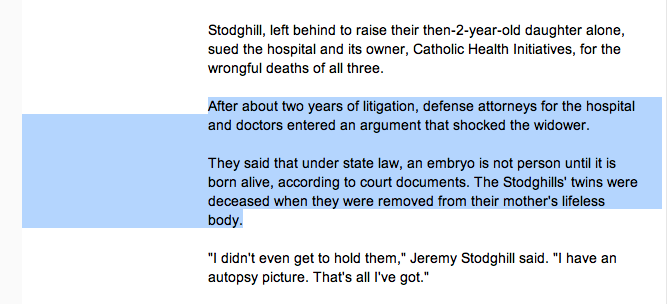
Now, in scientific rhetorics, an embryo becomes a fetus around week 8 or 9 of gestation. Since Lori Stodghill’s pregnancy was 20 weeks beyond that–she was in her third trimester, not her first–the choice to invoke the term “embryo” is a little bit shocking. Using the term “embryo” rather than “fetus” creates additional distance from the term “person”; this rhetorical move seems to make Jeremy Stodghill’s position weaker. In the interest of making apparent those responsible for this rhetorical shift … As nearly as I can tell (after an hour’s worth of Internet research), it was the CNN reporters who introduced this term rather than the attorneys for St. Thomas More Hospital or the Colorado law they relied upon; regardless, the slippage in terms is quite intriguing.
 Erin Anne Clark
You must be logged in to post a comment.